- Like
- Digg
- Del
- Tumblr
- VKontakte
- Buffer
- Love This
- Odnoklassniki
- Meneame
- Blogger
- Amazon
- Yahoo Mail
- Gmail
- AOL
- Newsvine
- HackerNews
- Evernote
- MySpace
- Mail.ru
- Viadeo
- Line
- Comments
- Yummly
- SMS
- Viber
- Telegram
- Subscribe
- Skype
- Facebook Messenger
- Kakao
- LiveJournal
- Yammer
- Edgar
- Fintel
- Mix
- Instapaper
- Copy Link
Purpose:
This drill is designed to help players develop both individual skills, such as passing, dribbling, and ball control, and essential team skills like communication, positioning, and teamwork. The 8 versus 8 format simulates real-game scenarios, allowing players to practice offensive and defensive tactics, learn to work effectively as a unit, and make quick decisions under pressure. The drill also encourages players to build endurance, improve spatial awareness, and understand the importance of transitioning between attack and defense.
Setup:
Mark off a 30-yard by 50-yard area on the field to create a suitable playing space for an 8 versus 8 game. Place a goal at each end of the area to simulate a game environment. Make sure the goals are properly secured and positioned in the center of each end line. Ensure there is enough space around the perimeter of the playing area for players to maneuver safely without risk of collision with any obstacles. Additionally, have enough cones or markers to clearly define the boundaries of the playing area, and prepare pinnies or colored vests to distinguish between the two teams.
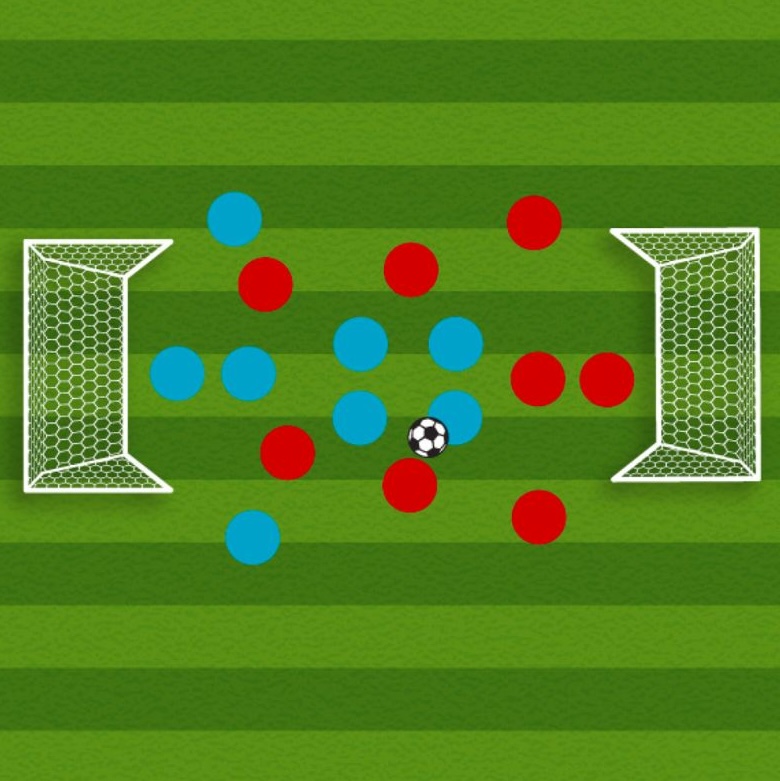
Instructions:
- Divide the players into two teams of eight, ensuring a balanced mix of skills and positions on each team to create a competitive environment.
- Assign one player from each team to be the goalkeeper and position them in their respective goals. Make sure the goalkeepers understand their roles and responsibilities, such as directing the defense and staying aware of their positioning.
- Start the game by blowing the whistle or calling out “Go.” Encourage both teams to begin with high energy, immediately applying pressure on offense and defense.
- Allow the game to flow for 10-20 minutes, stopping only for brief coaching points, hydration breaks, or to address any significant issues like fouls or misunderstandings about the rules.
- Throughout the game, encourage players to focus on both individual skills, such as dribbling and passing, and team tactics like maintaining shape, communication, and transitioning between attack and defense.
- At the end of the game, provide feedback on key areas of performance, such as teamwork, positioning, and decision-making, to help players improve their understanding and execution in future sessions.
Coaching Tips:
- You may want to encourage a double team when the attacker is in a tight spot, like near the sideline, or doesn’t have good support (for instance, a single forward going down the middle without supporting runs).
- Defenders should be communicating during the match and letting each other know who they are marking and who needs to be marked.
- When dribbling, they should have their head up and their eyes scanning the pitch. They should also dribble with speed and use fakes and feints with the ball to get past defenders.
Tips for Younger Athletes:
- Encourage younger players to focus on simple, effective passing. Reinforce using the inside of the foot for accuracy and making shorter, controlled passes to build confidence.
- Remind them to maintain a good defensive shape by staying goal-side of their opponent and keeping an eye on both the ball and their assigned player.
- Encourage them to use their voice for communication, whether calling for the ball or signaling teammates about defensive assignments. Building confidence in communicating on the field is crucial for young players.
Tips for Older Athletes:
- Challenge older players to increase their speed of play by limiting touches and making quicker decisions under pressure. This simulates real-game situations and helps them become more effective in tight spaces.
- Focus on advanced positioning tactics, such as pressing high to win the ball back quickly when possession is lost or creating passing lanes by making intelligent off-the-ball runs.
- Encourage experienced players to anticipate the flow of the game, reading their opponents’ movements to make interceptions or disrupt passing lanes effectively.
- Like
- Digg
- Del
- Tumblr
- VKontakte
- Buffer
- Love This
- Odnoklassniki
- Meneame
- Blogger
- Amazon
- Yahoo Mail
- Gmail
- AOL
- Newsvine
- HackerNews
- Evernote
- MySpace
- Mail.ru
- Viadeo
- Line
- Comments
- Yummly
- SMS
- Viber
- Telegram
- Subscribe
- Skype
- Facebook Messenger
- Kakao
- LiveJournal
- Yammer
- Edgar
- Fintel
- Mix
- Instapaper
- Copy Link